

Height comparison guide: height differences, country averages and shareable charts
A number tells you the difference; a shared scale helps you see it. This guide works through a 180 cm versus 165 cm example, explains country reference heights, and shows how to create your own comparison card.
Open the height comparison tool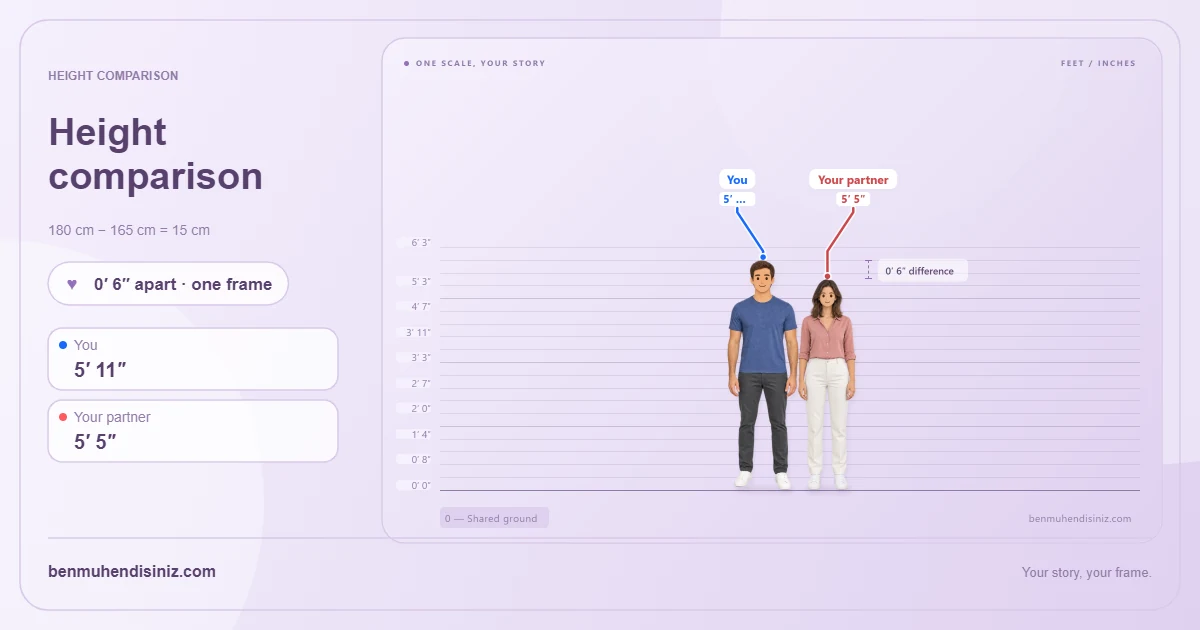
How to calculate a height difference
For two people, subtract the shorter height from the taller height. Our example is 180 − 165 = 15 cm. Moving the shorter person to the other side of the scene does not change that result. Equal heights have a difference of zero.
For a group, distinguish the overall range from the gap between a particular pair. With heights of 180, 165 and 120 cm, the overall range is 60 cm. That does not mean every pair is 60 cm apart. The tool’s group result shows the difference between the tallest and shortest person.
Relative to the taller height, 15 cm is approximately 8.3% of 180 cm. A percentage needs a stated denominator: using 165 cm instead produces a different percentage. For a visual comparison, the centimetre difference alongside the shared ruler is usually easier to interpret.
Why the shared ground line matters
People closer to a camera can look larger in a photograph. In this tool, all entered heights use the same scale and ground line. The ratio between the 180 cm figure and the 165 cm figure comes from those measurements. Moving figures sideways or zooming the scene does not change the underlying heights.
The figures are illustrations. Hairstyles, clothing, footwear and body shapes are not precise anatomical measurements. The tool visualizes heights you already know; it does not measure you with a camera, infer height from a photograph, or predict growth. Choosing a child appearance is not an age-based growth prediction.
Compare centimetres with feet and inches
One inch is exactly 2.54 cm and one foot is 12 inches. To convert, use (feet × 12 + inches) × 2.54. For example, 6 ft 1 in equals 185.42 cm and 5 ft 5 in equals 165.10 cm. The gap between those two values is 20.32 cm.
The unit switch changes between centimetres and feet/inches while preserving the stored height. Card labels may round to the nearest whole inch. Our 180 cm and 165 cm figures therefore appear as approximately 5 ft 11 in and 5 ft 5 in on the English card. Use the original centimetre values for exact arithmetic rather than converting the rounded labels back.
What you can do with the comparison tool
Start with a couple, family or friends preset. Give people names, enter heights from 40 to 250 cm, and add up to 10 people. Side-by-side and supported hug poses, different outfits, adult and child appearances, headscarf options and label colours help you personalize the scene.
Move figures, adjust their spacing, sort from shortest to tallest or tallest to shortest, and use the camera controls to explore larger groups. Backgrounds, sourced celebrity entries, and object or animal references provide other ways to compare. Read each celebrity’s source notes and any illustrative-height notice.
For a country comparison, select an adult figure and a country. The tool shows the difference from the relevant reference mean and the uncertainty interval around that estimate. The country table below uses the same data file as the tool, keeping the reference values consistent.
How to read average height by country
These are country- and sex-specific mean height estimates for 19-year-olds in 2019, from the NCD-RisC study published in The Lancet in 2020. The table includes the six countries available in the tool. Values are in centimetres, rounded to one decimal place.
| Country | Male · age 19 | Female · age 19 |
|---|---|---|
| Türkiye | 176.4 cm | 161.8 cm |
| United States | 176.9 cm | 163.3 cm |
| Germany | 180.3 cm | 166.2 cm |
| United Kingdom | 178.2 cm | 163.9 cm |
| Japan | 172.1 cm | 158.5 cm |
| South Korea | 175.5 cm | 163.2 cm |
Within this six-country selection, the male reference is 180.3 cm for Germany and 172.1 cm for Japan; the female reference is 166.2 cm for Germany and 158.5 cm for Japan. Türkiye’s references are 176.4 and 161.8 cm. A height of 180 cm is approximately 3.6 cm above Türkiye’s male reference and 0.3 cm below Germany’s. This is a selected-country comparison, not a world ranking.
These figures are not current averages for all adults, ideal heights or individual assessments. Keep age, year and methodology consistent. A 95% uncertainty interval for an estimated mean does not describe the range containing 95% of people. Each country name links to its source CSV.
Data source: NCD-RisC / Lancet 2020 ↗Create your own height comparison
- Open the tool and select a couple, family or friends scene.
- Enter names and known heights, checking whether the input uses cm or feet/inches.
- Read the shared ruler. For country comparisons, check the reference year and age group.
- Choose poses, outfits, arrangement and card design.
- Check the preview, then download the image or share the comparison link.