What Is Python? A Simple Guide for Beginners
What Is Python?
Software is how we tell a computer, phone or server what to do. Python is one of the programming languages used to write those instructions.
Put simply:
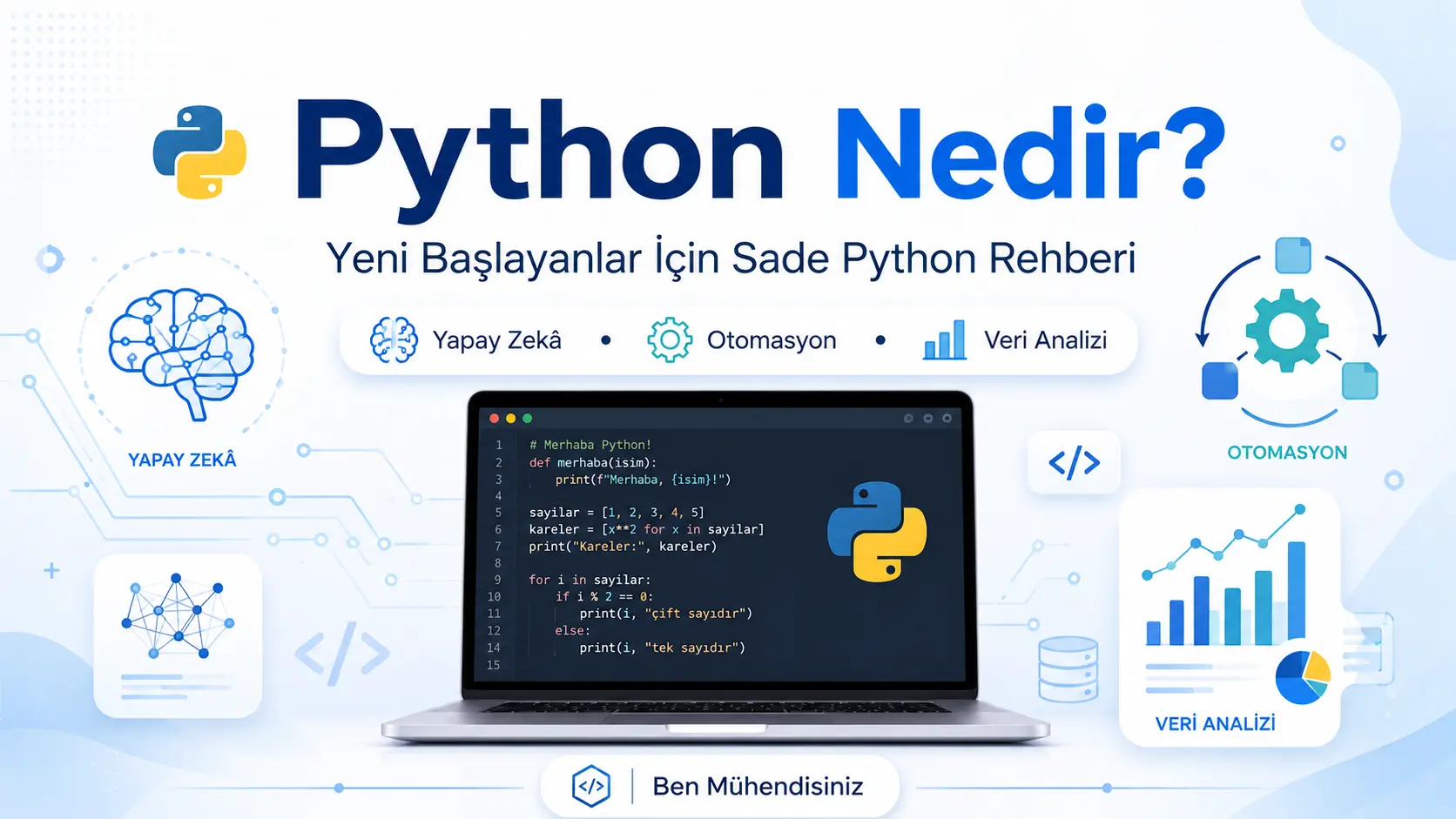
Python is a programming language that lets you give computers clear instructions to build programs, automation, analyses, AI models and web systems.
One of Python’s greatest strengths is its readable code, which resembles human language. This often makes it easier for beginners to learn. Python’s official website also describes how the language helps you work quickly and integrate systems more effectively.
For example, this is all the Python code you need to display some text:
print("Merhaba dünya")
The code simply displays “Merhaba dünya”, Turkish for “Hello world”.
This simplicity matters when you are starting out. Your first goal is to understand programming logic without getting overwhelmed by complex structures.
Why Is Python So Popular?
Python is popular for more than its approachable appearance. The main reason is that, despite its simplicity, it can be used in many different fields.
With Python, you can:
Develop AI applications.
Analyse data.
Automate Excel, file management, email and reporting tasks.
Build the backend of a website.
Connect to APIs.
Develop small desktop tools.
Create custom software solutions for businesses.
The Python documentation also includes an official tutorial introducing basic concepts. It is a useful starting point for people who want to learn the language.
Python is more than an easy language to learn: it is a practical tool for real projects.
Who Is Python For?
Python is particularly suitable for:
People New to Programming
Python is a good starting point for learning programming logic. Its readable structure avoids much of the punctuation, complex brackets and unnecessarily lengthy code found elsewhere.
People Interested in AI
Python is widely used in artificial intelligence, machine learning and data processing because its ecosystem includes many powerful libraries for these fields.
People Who Work with Data
Python can analyse spreadsheets, sales reports, customer data, student performance, product statistics and financial data.
People Tired of Repetitive Tasks
Editing the same files, preparing the same reports, checking emails and transferring similar data every day takes time. Python can automate these tasks.
People Who Want to Build Software Projects
Python can also be used for backend development and custom software. It can be a strong option for systems that handle large amounts of data.
What Can You Do with Python?
Python has a wide range of applications. The following categories make them easier for beginners to understand.
1. Artificial Intelligence and Machine Learning
AI involves developing systems that can derive meaning from data.
Examples include:
Recognising objects in an image
Making recommendations based on user behaviour
Classifying text
Processing voice commands
Building prediction models
Python is a common choice because many AI and machine learning tools work with it.
The important distinction is that Python itself is not AI. It is a language used to develop AI systems. Like a pen, what it produces depends on how you use it.
2. Data Analysis
Imagine a business with hundreds of orders, customer records, payments and product sales. When that information is scattered, making decisions becomes difficult.
Python can read, clean, group and make sense of this data.
For example, you can:
Find the best-selling products.
Analyse which months generated the most revenue.
Chart student performance.
Explore user behaviour.
Identify incorrect or missing data.
Data analysis is useful beyond large companies. Small businesses, schools, online shops and many service providers can benefit too.
3. Automation
Automation is one of Python’s most practical uses.
Automation means letting software perform repetitive tasks.
Suppose you prepare the same report every week: you open files, copy data, edit rows and export the result to another file. Doing this manually takes time and creates opportunities for mistakes.
Python can automate the process.
Example automation projects:
Editing Excel files
Renaming files in a folder in bulk
Creating email reports
Extracting data from a website
Splitting or merging PDF files
Running daily backups
Checking specific data and generating alerts
This makes Python useful both for developers and for anyone who wants to speed up their work.
4. Web and Backend Development
A website’s hidden workings matter as much as its visible interface. Logins, registration, payment records, database connections and admin functions run on the backend.
The backend is the part of an application that manages data behind the scenes.
Python can power backend systems such as booking services, student tracking dashboards, data management tools and custom admin panels.
Python is not automatically the best choice for every project. Next.js, Supabase, Firebase or other technologies may sometimes be more suitable. The decision should follow the project’s needs.
Where Should You Start Learning Python?
A common mistake is jumping straight into AI or large projects.
A better approach is:
1. Learn the Fundamentals
Start by understanding these concepts:
A simple example:
isim = "Mehmet"
yas = 25

print(isim)
print(yas)
Here, isim and yas are variables. Variables store data.
2. Build Small Applications
Watching videos and reading articles are not enough on their own. You also need to build small applications.
Beginner project ideas:
3. Do Not Be Afraid of Errors
Errors are a normal and important part of learning to code.
Error messages may look intimidating at first, but over time they become useful guides.
4. Choose a Focus
Once you have learned Python, choose a field to focus on.
For example:
Artificial intelligence
Data analysis
Automation
Backend development
Web scraping
API development
Trying to learn everything at once can be confusing. Learn Python’s foundations first, then move into your chosen field.
Is Python Difficult to Learn?
Python is generally approachable for beginners, but learning it still takes effort.
The main challenges are:
Understanding programming logic
Learning to resolve errors
Moving on to real projects
Writing clean, maintainable code
Understanding databases, APIs and user flows
Python’s syntax may be simple, but developing good software still requires planning, practice and guidance.
What Should You Consider When Building a Python Project?
Asking whether a Python project works is not enough.
There are several other things to consider:
Define the Project’s Purpose
Answer these questions first:
What problem will the software solve?
Who will use it?
What data will it process?
Which manual task will it simplify?
How will it be managed as it grows?
Keep the Code Clean
Code should be understandable to more than its author. It should be organised, readable and easy to extend.
Consider Data Security
Security matters when processing user details, payment data, reports or private files.
Plan for Growth
A system that works for ten users today may struggle with a thousand tomorrow. Plan the database, file structure and server carefully.
Remember Maintenance
Software is not finished when it launches. Bugs need fixing, new requirements emerge and performance needs improving.
Why Do Python and AI Matter for Businesses?
Many people think AI is only for large technology companies, but intelligent systems can also be developed on a smaller scale.
For example, a business can:
Classify customer requests.
Analyse sales data.
Generate reports automatically.
Interpret user behaviour.
Automate common tasks.
Python can help make these business processes easier to understand and manage.
However, not every problem needs AI.
Sometimes a simple automation is a better solution than a complex AI system. Analyse the need first, then choose the technology.
How Long Does a Python Project Take?
The timeline depends on the project’s scope.
A simple automation may take a few hours or days. A more extensive data analysis system, admin panel, API or custom AI-assisted application may take weeks.
The main factors include:
The project’s purpose
The amount of data to process
User roles
Whether an admin panel is needed
Database structure
API integrations
AI model requirements
Security requirements
Reporting and visualisation needs
Maintenance and development expectations
Understanding the scope is essential before giving a firm timeline.
What Determines the Cost of a Python Project?
There is no fixed cost because projects vary in complexity.
Some questions that affect pricing:
Is it just a simple script?
Will there be a user dashboard?
Will it use a database?
Will it connect to external services?
Does it include an AI model?
Are data analysis and charts needed?
Will a web dashboard manage the system?
Does it need security and permissions?
Will deployment and maintenance be included?
An automation that only edits Excel files is very different in scope from a system with user accounts, an admin panel and data analysis.
Clarify the requirements before estimating the price.
Common Mistakes When Learning Python
Beginners often encounter the same pitfalls.
Only Watching Videos
Videos are useful, but learning will not stick without writing code.
Starting a Large Project Too Early
Build a solid foundation first. Otherwise, resolving errors becomes harder as the project grows.
Ignoring Error Messages
Error messages often indicate where the problem is. Trying random solutions without reading them wastes time.
Learning Through Copy and Paste Alone
Existing code can be useful, but copying without understanding its logic weakens learning.
Jumping Between Fields
Switching from AI to web development, games and automation before mastering the basics makes learning scattered. Follow a more structured plan.
Does It Make Sense to Start with Python?
Yes. Python can be a sensible starting point for someone new to programming.
Reasons include:
Its readable structure.
Its wide range of uses.
Its strengths in AI, data analysis and automation.
Its accessibility for learning basic programming logic.
Its usefulness in real projects.
Learning Python alone is not enough, however. Problem analysis, technology choices, database design, security, user experience and maintenance also matter in software development.
Python and Software Development with Ben Mühendisiniz
Python can be a strong choice for AI, automation and data analysis, but each project should start with a careful assessment of its needs.
Sometimes a small Python automation is enough. Other projects need a more comprehensive backend, admin panel, mobile app or web management dashboard.
Ben Mühendisiniz can support planning, development and maintenance for websites, mobile apps, custom software, backends and projects using Supabase, Firebase, Next.js and Flutter.
The aim is to build a system that works and is also understandable, manageable, secure and adaptable over time.
Conclusion
The simplest answer to “What is Python?” is this: it is a clear, powerful and versatile programming language for telling computers what to do.
Its approachable structure makes it a good starting point for beginners. It is useful in fields such as AI, automation, data analysis and backend development.
To learn Python, understand programming fundamentals, practise with small projects and then move into your chosen field.
To commission a Python project, clarify your needs, define its scope and proceed with a sound technical plan.
Python FAQs
What is Python?
Python is a clear, powerful programming language used for software development, including AI, data analysis, automation and backends.
Is Python difficult to learn?
Python is relatively accessible for beginners. Developing good software still requires regular practice and an understanding of programming fundamentals.
Can you build AI with Python?
Yes. Python is widely used in AI and machine learning, with many powerful libraries in its ecosystem.
Can Python automate tasks?
Yes. Python can automate repetitive work such as editing spreadsheets, handling files, generating reports, checking email and extracting data.
Is Python suitable for data analysis?
Yes. Python is widely used to clean, analyse, report on and visualise data.
Where should I start learning Python?
Start with variables, data types, conditionals, loops, functions, lists and dictionaries. Then practise with small projects.
How long does a Python project take?
It depends on the scope. Simple automations can be built quickly, while systems with admin panels, databases or AI features may take longer.
Is Python the right choice for every project?
No. Python is powerful, but it may not always be the best option. Consider the project’s purpose, user numbers, performance expectations and technical requirements.



Comments (0)
No comments yet. Be the first!
Leave a comment