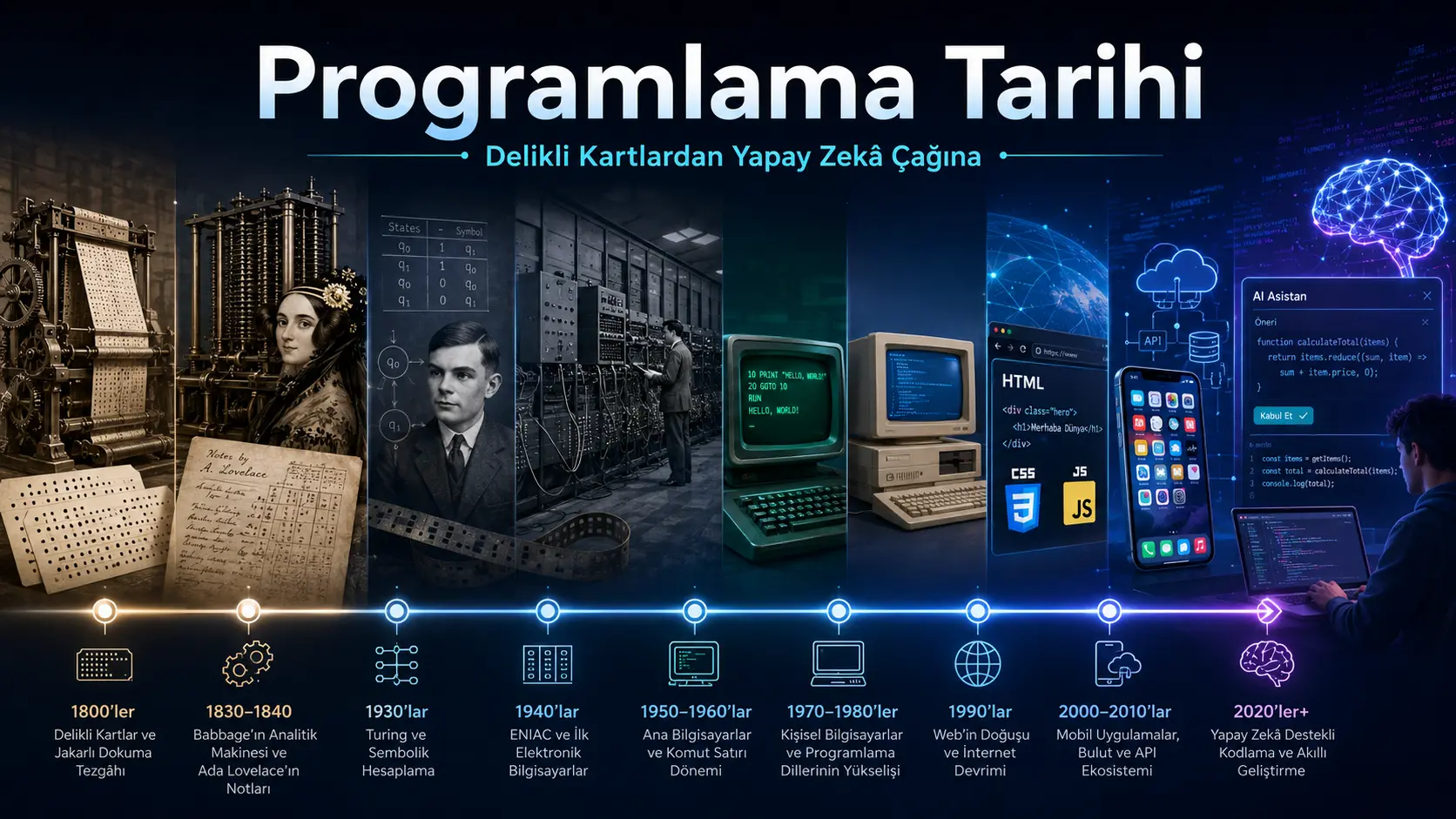
The History of Programming: From Punched Cards to AI-Assisted Development
When Did People First Ask a Machine to Understand Them?
Imagine a machine.
It has no screen, keyboard, internet connection or glowing logo. There are only gears, cards, cables, holes and human patience.
Today, a few lines of code can launch a mobile app. A website can reach someone on the other side of the world in seconds. An AI assistant can read code and suggest where an error lies.
The story did not start that way.
The history of programming is the story of people learning to instruct machines: a long journey shaped by mathematics, curiosity, mistakes, patience and imagination.
Along the way appear a loom, an unfinished machine, rooms full of cables and a small cursor blinking on a dark terminal.
Let’s return to the beginning.
1. Before Code Looked Like Code
The idea of programming emerged long before modern computers.
In 1801, Joseph Marie Jacquard demonstrated a loom controlled by punched cards. Holes in the cards determined which threads the mechanism raised. A hole was either present or absent, an idea reminiscent of the ones and zeros used much later in computing. Punched cards let the loom produce complex patterns automatically and inspired early computer technology.
Nobody described this as software development at the time.
But the underlying action was familiar:
A person gave a machine a prepared set of instructions.
That is the essence of programming.
Instructions were prepared, the machine followed them and a result appeared. Today’s code follows a similar logic, with data instead of threads, files instead of cards and computers instead of mechanical looms.
2. Ada Lovelace: Imagining Code Before the Computer Existed
Charles Babbage and Ada Lovelace then enter the story.
Babbage designed a mechanical calculating machine called the Analytical Engine. It was never completed in full, but the idea was ambitious: a general-purpose machine that processed numbers according to instructions.
Lovelace saw more than a calculator in that idea.
She imagined a machine working with music, symbols and more complex processes, not just arithmetic. Her notes on the Analytical Engine described an algorithm for calculating Bernoulli numbers. Many accounts recognise it as the first published computer program, although scholars also debate the respective contributions of Babbage and Lovelace.
The important idea was:
Lovelace saw that a machine could do more than calculate if its task could be described appropriately.
This remains a fundamental idea in software.
A modern app also does more than calculate. We instruct it to log users in, save data, take payments, send notifications, support administration and produce reports.
We give the machine behaviour.
3. Alan Turing: Programming as a Way of Thinking
The story took another turn in 1936.
Alan Turing explored computability in “On Computable Numbers”. The theoretical model now called a Turing machine operates on symbols using simple rules. His work became one of the theoretical foundations of computer science.
Turing asked a crucial question:
What can a machine compute, and what can it not compute?
Programming involves more than commands. It means dividing problems into parts, ordering operations and understanding what is possible.
Modern projects follow the same reasoning.
When a customer wants a booking system with payments and notifications, a developer first asks:
What are the components?
What data must be stored?
Which steps will users follow?
Which operations will be automatic?
When should the system report an error?
A strong connection links Turing’s theoretical work to everyday development.
4. ENIAC: Programs Among the Cables
By the 1940s, computers were more than ideas on paper.
ENIAC was one of the first general-purpose, programmable electronic computers. Programming it did not mean typing code and pressing Run: it involved reconnecting cables, setting switches and changing physical configurations. Six pioneering women played key roles: Betty Snyder, Kathleen McNulty, Jean Jennings Bartik, Ruth Licherman, Frances Bilas and Marlyn Wescoff. They worked without the familiar programming languages and manuals available today.
That environment is difficult for a modern developer to imagine.
Imagine finding an error without a terminal, console, error message or stack trace.
There are only cables.
One misplaced connection can change the result.
The lesson is:
Programming requires understanding the system as well as writing instructions.
That remains true today. Flutter, Next.js, Supabase, Firebase, backends, APIs, databases and hosting are parts of a system. A developer needs to understand both the interface and the infrastructure behind it.
5. Grace Hopper and Compilers: Bringing Code Closer to People
Early computers required instructions at a very low level, close to the machine’s own language.
Pioneers such as Grace Hopper helped change that.
Hopper’s A-0 system, developed in 1951–1952, was an important step in automatic programming and subroutine management. The broader compiler idea was simple: people write in a more understandable language, and a system translates it into a form the machine can execute.
This was a major shift.
People no longer had to express everything directly in machine-level instructions. Tools could translate more readable expressions.
The principle still applies.
A developer writes:
print("Merhaba dünya")
An interpreter or compiler handles the work needed to execute that instruction.
Modern languages rely on systems that bridge human-readable code and machine execution.
6. Fortran and COBOL: Programming Becomes a Profession
By the late 1950s, programming was becoming more organised and widespread.
IBM introduced Fortran in 1957 for scientific and mathematical computation. It helped establish high-level programming languages.
Its central idea was:
Scientists and engineers should be able to express formulas without struggling with machine code.
COBOL followed, designed for business, finance, records and enterprise data processing. Hopper’s earlier work and languages such as FLOW-MATIC influenced its development. The first COBOL specifications appeared in 1959.
Programming was developing distinct specialisms:
Fortran served laboratories and engineers.
COBOL served banks, government and business.
Software was becoming more than a way to operate a machine.
Different needs were producing different languages.
The pattern continues with Flutter for mobile apps, React or Next.js for web interfaces, Node.js for backends, Python for data analysis and C++ for performance-sensitive work.
Each tool has its own character.
7. C and Unix: Making Software More Portable
The 1970s brought another influential language: C.
Dennis Ritchie played a central role in C’s development at Bell Labs, alongside the Unix operating system. C balanced low-level system control with more readable high-level structures.
Its strength was:
It worked close to the machine without requiring everything to be written as machine code.
This made it influential in operating systems, embedded devices, performance-sensitive programs and hardware-related work.
C helped strengthen programming’s engineering foundations.
Memory management, data structures, pointers, system calls and file operations encouraged developers to ask how the machine would carry out a task, as well as what the task should be.
Its influence is visible in many later languages.
Java, C++, C#, JavaScript and numerous system tools reflect parts of that legacy.
8. Personal Computers: Code Comes Home
The 1980s and 1990s opened another chapter.
Computers spread beyond universities, military institutions and large companies into homes, schools and small offices.
BASIC introduced many people to programming.
You typed a simple line:
10 PRINT "MERHABA"
20 GOTO 10
And the machine responded.
It could feel magical.
Programming became accessible to curious students, hobbyists and aspiring engineers, rather than remaining confined to specialist workplaces.
Software culture changed.
People wrote games.
They developed accounting programs.
They built desktop tools for small businesses.
Schools introduced computing lessons.
Programming became more visible.
Work once performed by reconnecting cables became lines typed on a keyboard.
9. The Web: Code Reaches the World
In 1989, Tim Berners-Lee proposed the World Wide Web while working at CERN, aiming to make information sharing easier for scientists in different places.
Early pages were simple.
There was HTML.
There were links.
There was text.
Then people wanted more:
Pages should respond, not just be read.
Brendan Eich created JavaScript in 1995. It became central to interactive web pages and was later standardised through ECMA, forming a foundation of modern web development.
This was a major turning point.
Software was no longer confined to one computer.
It moved into browsers.
It connected to the internet.
It became accessible across the world.
Commissioning a website today continues this history. Modern sites require coordinated decisions about design, performance, SEO, security, mobile layouts, administration, data and user experience.
The web made programming more visible and more commercially significant.
10. Python: Code Can Be Readable
Guido van Rossum released Python in 1991. Its clear syntax and emphasis on readability helped it spread from education to data science, AI and web development.
Python reinforced an important message:
Code should be readable by people as well as executable by machines.
That idea remains valuable.
Projects evolve. Features are added, bugs are fixed and new developers join.
Unreadable code makes ageing projects harder to manage.
Asking whether software works is therefore not enough.
We also ask:
Is the code understandable?
Can it be extended?
Is maintenance straightforward?
Can another developer take over?
Can errors be addressed quickly?
Python’s popularity owes much to this emphasis on clarity.
11. The Mobile Era: Software in Our Pockets
During the late 2000s and 2010s, software became a constant companion.
Smartphones, app stores and mobile internet transformed development.
Software no longer needed to stay on desktops or in browsers.
People could open an app on the bus.
Share a location.
Receive notifications.
Upload photographs.
Make payments.
Chat in real time.
Mobile development became a major field in its own right.
Swift became prominent for iOS and Kotlin for Android. Cross-platform tools such as Flutter and React Native made it easier to support both from a shared codebase.
The larger change was:
Software moved closer to everyday life.
A website is usually somewhere a person visits.
An app stays on their phone.
Performance, user experience, security, notifications, synchronisation and maintenance became especially important.
12. Cloud Services, APIs and Backends: The Hidden System Grows
The invisible parts of software became as important as the visible interface.
A user presses a button.
Many things happen behind the scenes.
Data reaches a server.
Permissions are checked.
A record is saved.
A notification is triggered.
A payment is verified.
The admin panel receives an update.
This hidden part is the backend.
Backends manage data and operations such as accounts, payments, messages, files, permissions and administration.
Cloud infrastructure made development more flexible.
Many projects no longer need their own physical servers. Platforms such as Supabase, Firebase, AWS, Vercel and Cloudflare help teams build scalable and manageable systems.
The lesson was:
Modern software involves more than code.
It includes infrastructure, security, data modelling, scalability and maintenance.
13. Open Source: Code Grows Through Sharing
Open-source culture is another important part of this history.
A developer shares code.
Someone else examines it.
Another person fixes a bug.
A community writes documentation.
Over time, a small project can become a tool used worldwide.
Linux, Git, Python libraries, JavaScript packages, open-source databases and frameworks reflect this culture.
Sharing accelerated development.
Libraries, packages, frameworks and services mean we do not have to build every part from scratch.
There is still an important responsibility:
Using an existing tool does not remove the need to understand the system.
Good developers consider what each tool does, what it contributes and the maintenance it may require.
14. The AI Era: Describing and Evaluating the Work
That brings us to the present.
Programming has entered another chapter.
AI coding assistants work alongside developers. GitHub Copilot can suggest lines and functions using context from the current file and surrounding code.
In 2025, GitHub made its Copilot coding agent generally available, offering a more autonomous workflow in which an agent can take on tasks and make changes.
OpenAI introduced Codex as a software engineering agent capable of writing code, debugging, running tests and handling codebase tasks in isolated cloud environments.
This changes the role of the developer:
Programming involves more than typing code.
It also involves defining problems, planning systems, evaluating outputs and managing quality.
AI can write code.
People still need to determine the purpose, relevant data, user difficulties and security requirements.
AI is changing the programmer’s role rather than simply making it unnecessary.
Previously, a common question was:
“How do I write this code?”
Now another question matters:
“How do I describe, verify and maintain this system correctly?”
15. A Small Example of Changing Languages
Different eras expressed the same idea differently.
The goal remained similar:
Make the machine say hello.
In C:
#include <stdio.h>

int main() {
    printf("Merhaba dünya");
    return 0;
}
In JavaScript:
console.log("Merhaba dünya");
In Python:
print("Merhaba dünya")
Even this small example illustrates the direction of change.
Code has often become shorter, more readable and closer to human expression.
The underlying process remains:
Give instructions.
Define the sequence.
Process data.
Produce a result.
16. What Can Developers Learn from the Past?
Several lessons stand out.
First, technology changes while fundamentals remain. Variables, conditionals, loops, functions, data structures and algorithms still underpin software.
Second, software is more valuable when it is maintainable, secure, understandable and extensible, as well as functional.
Third, each era brings tools: punched cards, cables, compilers, terminals, web frameworks, mobile SDKs, cloud services and AI agents. Problem-solving remains central.
Fourth, programming responds to human needs. Scientists need calculations, banks need records, students need schedules, businesses need bookings and users need fast, convenient applications.
Software’s value depends on how well it understands those needs.
17. What Does This History Mean Today?
It is more than a collection of old machines.
It matters to anyone planning a website, mobile app or custom software project.
The past shows us:
Good software does not happen randomly.
It needs planning.
Appropriate technology.
Clear design.
A secure backend.
A sound data model.
Maintenance and continued development.
The appearance of a screen is only one question.
Also consider:
How will users register?
Where will data be stored?
Will there be an admin panel?
How will mobile use be supported?
Will performance be sufficient?
Can the system grow?
How will maintenance work?
Are AI or automation actually needed?
Answering these early supports a healthier project over time.
Conclusion: The Story of Code Is a Story of Organising Ideas
Programming has travelled from punched-card instructions to AI-assisted development.
Machines first performed mechanical movements.
Then they calculated numbers.
Languages emerged.
The web arrived.
Mobile apps entered everyday life.
AI became another assistant alongside developers.
At the centre remains a familiar process:
Someone sees a problem.
Breaks it into parts.
Turns it into a system.
Explains it to a machine.
Commissioning software today means building a well-planned, usable, secure, manageable and adaptable system, not merely obtaining code.
History makes this clear:
Code changes.
Tools change.
Well-designed systems remain valuable.
Programming History FAQs
How did programming begin?
Its roots lie in machines following prepared instructions. The punched-card Jacquard loom is an early example.
Who was the first programmer?
Ada Lovelace is often recognised as the first computer programmer for her Analytical Engine algorithm, although historians also discuss Babbage’s contributions.
What was the first programming language?
Fortran, introduced by IBM in 1957, was one of the first widely used modern high-level languages.
Why do languages keep changing?
Scientific work, business, the web, mobile apps, AI and cloud systems create different needs, encouraging new languages and tools.
Will AI replace programmers?
AI can accelerate coding, find errors and suggest solutions. Understanding problems, planning systems and evaluating security and quality still require human expertise.
What matters when commissioning software today?
Plan the purpose, user roles, screens, backend, admin tools, security, performance, maintenance and potential growth from the beginning.



Comments (0)
No comments yet. Be the first!
Leave a comment